

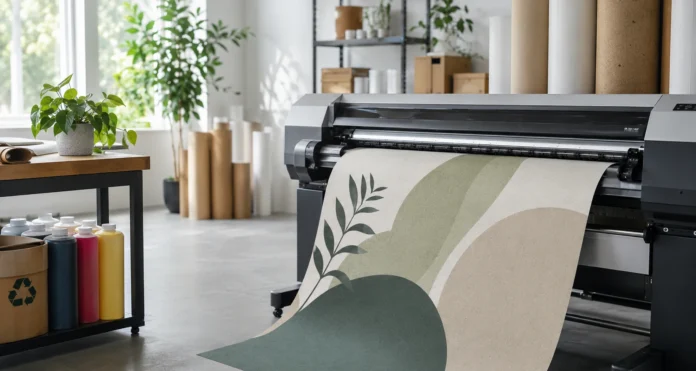
Large format printing has long faced criticism for its environmental impact. Traditional substrates, solvent-based inks, and short-lived promotional campaigns have all contributed to the perception that eye-catching graphics come at a high environmental cost.
But that picture is changing. Advances in materials, printing technology, and production methods are helping businesses reduce waste without compromising on quality or durability. While no manufacturing process is entirely impact-free, the large format print industry is evolving rapidly, proving that sustainability and visual impact no longer have to be competing priorities.
Sustainable Materials Are Expanding the Options
For many years, businesses had limited alternatives to conventional PVC-based materials when producing banners and display graphics. Today, manufacturers are developing products that incorporate recycled content, reduce reliance on virgin plastics, or are designed with end-of-life recycling in mind.
This gives brands more flexibility when selecting materials that align with their environmental objectives while still meeting the practical demands of outdoor advertising and event signage.
For example, choosing sustainable frontlit banner material allows businesses to specify products developed with both print performance and environmental considerations in mind, supporting more responsible large-format campaigns.
Digital Printing Produces Less Waste
One of the biggest environmental improvements has come from digital printing itself. Unlike traditional methods that often require extensive setup, printing plates, and lengthy test runs, digital workflows allow graphics to be produced directly from digital files. This reduces material waste, shortens production times, and makes smaller print runs economically viable.
Printing only what is needed also helps prevent excess stock that may never be used.
Inks Have Become More Environmentally Friendly
The chemistry behind printing has changed considerably over the past decade. Many printers now use water-based, latex, or UV-curable inks that contain lower levels of volatile organic compounds (VOCs) than traditional solvent-based alternatives. These technologies not only reduce emissions during production but also provide vibrant, durable graphics suitable for demanding indoor and outdoor applications.
As ink formulations continue to improve, sustainability gains are being achieved without sacrificing color quality or longevity.
Durability Is an Environmental Advantage
Sustainability is not only about how a product is made. It is also about how long it lasts. A banner that remains in excellent condition throughout a lengthy campaign is less likely to require replacement, reducing the consumption of additional materials, transport, and installation resources. Durable graphics can even be reused across multiple events, further lowering their overall environmental footprint.
Designing for longevity has become just as important as choosing sustainable materials in the first place.
Smarter Design Is Reducing Unnecessary Consumption
Environmental improvements increasingly begin before anything reaches the printer. Designers are considering standard material widths to minimize offcuts, creating modular graphics that can be updated rather than replaced entirely, and specifying reusable display systems for recurring campaigns. These practical decisions help reduce waste throughout the production process while extending the useful life of printed assets.
The result is a more efficient approach that benefits both businesses and the environment.
Customers Are Driving Industry Innovation
Perhaps the biggest reason for change is customer demand. Organizations are placing greater emphasis on environmental responsibility across every part of their operations, including marketing and visual communications. Print providers have responded by investing in sustainable materials, cleaner production technologies, and recycling initiatives because these are increasingly expected rather than viewed as optional extras.
This demand is accelerating innovation across the sector and encouraging manufacturers to continue developing products with lower environmental impacts.
Sustainability Is Becoming Part of Every Print Decision
Large format printing may never be completely free of environmental impact, but it is becoming significantly more sustainable than many people realize. Through advances in materials, cleaner inks, digital production methods, and smarter design practices, the industry is steadily reducing waste while maintaining the high visual standards that brands expect. The result is a future where striking printed campaigns and responsible manufacturing increasingly go hand in hand.
